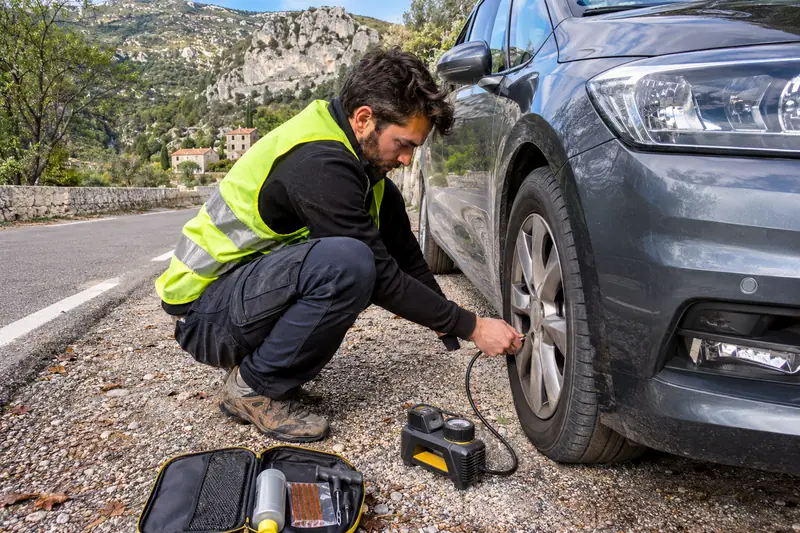
Safety before the spanner
A blow-out at speed is a shock: hold the wheel firmly, don't brake hard, and pull over as soon as you safely can. Then hazards flashing, the vest on before you step out, passengers off the road and behind the barrier where there is one. Never change a wheel on the traffic side of a fast road. On a motorway, don't try at all: use an orange emergency phone, the motorway company's app or 112.
Repair, spare wheel or new tyre?
Three ways to get going again, depending on the tyre and what's in your boot:
- Repair the tyre, if the hole allows it. It is the cheapest option, but only possible once the tyre has been taken off and inspected.
- Fit your spare wheel, to leave straight away and deal with the tyre later. Many recent cars carry only a repair kit, and no law requires a spare.
- Replace the tyre on the spot with a new one, when it can't be repaired, when it is worn, or when there is no spare.
If nothing will do, a rim bent against a kerb for example, the car is towed to the tyre fitter or garage you choose.
What can be repaired
The French tyre trade body (TNPF) publishes clear rules, and the first one is that the tyre must come off the rim: it is the only way to see what driving flat did to the inside.
| Where is the hole? | Repairable? |
|---|---|
| Tread, the part that touches the road | Yes, up to 6 mm |
| Shoulder, between tread and sidewall | No |
| Sidewall | Up to 3 mm, on a tyre whose speed letter is T (190 km/h) or below |
Even a small hole can't be repaired if the bead wire shows or is bent, if rubber or plies have come apart, if the inner liner shows marbling from running underinflated, or if a sidewall is damaged all the way round. The durable fix is a mushroom-shaped plug fitted from inside, and an inner tube never goes into a tubeless tyre.
On the spot, depending on the equipment of the professional sent out, the tyre is either repaired or given a temporary fix to reach a workshop. In the second case, have it checked off the rim within a few days.
A new tyre where the car stands
When the tyre can't be saved, or is simply worn, the professional comes with a new tyre in your size, takes off the old one, fits the new one on your rim and balances the wheel, outside your hotel, at a car park or at the roadside.
- The size is moulded on the sidewall, a string such as 225/45 R17 94W: width, sidewall height, rim diameter, then load and speed ratings. A photo of it is enough.
- The range is chosen in the form: budget, standard or premium.
- How many: one, two to keep matching tyres on an axle, or four.
- Already bought your tyres? Tick fitting only.
Tread depth: the legal minimum
The legal floor in France: 1.6 mm of tread depth across the main grooves, for the tyre's whole life; the little wear bars at the bottom of the grooves mark that depth. Run below it and you risk a €135 fine and having the car immobilised. A worn tyre also punctures more easily and grips less on a wet road, so look at the other three while the wheel is off.
Updated November 2026. Lire cette page en français.