The first two minutes
If the car is still rolling, get it off the road: a lay-by, a car park, a rest area, the next exit. Stopping on a hard shoulder is a last resort. Then:
- hazard lights on;
- high-visibility vest on before you open the door. Every car in France must carry one, and stepping out of a broken-down car at the roadside without wearing it is punishable by a €135 fine;
- everybody out, then over the crash barrier where there is one. Don't wait inside a car stopped in a lane, and don't stand between it and the traffic;
- the red triangle is set roughly thirty metres back, but only when the car still blocks part of the carriageway and you can walk there without risk. Parked wholly on the hard shoulder, you can leave it in the boot; and on a motorway, nobody walks along the lanes, since pedestrians are banned there.
Emergency: 112
112 is the European emergency number and it works from any mobile phone in France. Use it for an injury, a fire, smoke, a fuel smell, or a car blocking a lane where it could be hit. For everything else, a breakdown service will do.
On a motorway: the approved operator, at a set price
On French motorways (autoroutes) and some expressways, a breakdown is the business of one recovery firm, the one approved for that section. It wins that approval through a tender overseen by the State, and nobody else, us included, may send a truck. You alert the motorway company, which dispatches it:
- an orange roadside phone: one stands every 2 km and pinpoints your position for the operator;
- the motorway company's app: Ulys on the VINCI Autoroutes network, which includes the A7 and the A8, or SOS Autoroute on the APRR group's network and several other companies' motorways, AREA and ATMB in the Alps among them;
- 112 otherwise.
VINCI Autoroutes aims for an operator on site within 30 minutes for a car. The State revises the fee each year. For 2026, VAT included: €151.00 to repair on the spot, or to tow a car weighing 1.8 t or less, rising to €226.50 if you call in the evening, overnight, at a weekend or on a bank holiday; towing a vehicle of 1.8 to 3.5 t costs €186.72, or €280.08 at those times. That fee covers towing to the approved firm's depot, or to somewhere you pick no more than 5 km beyond the first exit. Anything further, any parts, and tolls if the tow leaves the motorway network, cost extra. You'll find the official rates posted inside the recovery truck and on the roadside phones, and you're entitled to an itemised invoice.
Your insurer or the rental company can take over once you're off the motorway. Pay the approved operator, keep the invoice and claim it back under your policy.
Tolls
Most long-distance motorways of the region are toll roads run by private companies, the A7 along the Rhône valley and the A8 along the coast among them. If you break down at a toll plaza, use the help button at the booth: the motorway company sends its approved operator, as for any other motorway breakdown.
Rental cars
Call the rental company first. Its breakdown number is on the rental agreement, often on the key fob or a sticker inside the windscreen, and the contract usually says who comes out and who pays. If you call someone else without its agreement, the cost may stay with you. Take photos of the car, the dashboard warning lights and the place, and keep every receipt.
If the car won't start in the rental car park at Nice Côte d'Azur, Marseille Provence (at Marignane) or Lyon Saint-Exupéry airport, go back to the rental desk: it is their car and their car park. Elsewhere, in a multi-storey or underground car park, note the name, the level, the bay number and the height limit at the entrance; a recovery truck may not fit under a low ceiling, and the car may first have to be pulled out with suitable equipment.
Accidents: the constat amiable
If someone is hurt, dial 112 first. For a minor collision between vehicles, the drivers usually fill in a constat amiable, the European accident statement. Its layout is the same in every language, so an English version can be matched box by box with the French one, and each driver keeps a copy signed by both. Don't sign anything you don't understand or disagree with: you can add your own remarks in the observations box. Then tell your insurer, or the rental company, as their contract requires.
Mountains, snow and the winter rule
Every winter, between 1 November and 31 March, mountain districts chosen by the prefects (34 departments for winter 2026-2027, the Alps and Corsica among them) apply an equipment rule, announced by road signs where each zone starts and ends. Either keep chains or snow socks in the boot, enough for two driving wheels, or run on four winter tyres carrying the three-peak snowflake symbol (3PMSF) as well as M+S. A tyre marked M+S only no longer counts. No fine can be issued for now, because the penalty decree has not been published, but without equipment the real risk is being stuck. Ask the rental company what the car has before you head up.
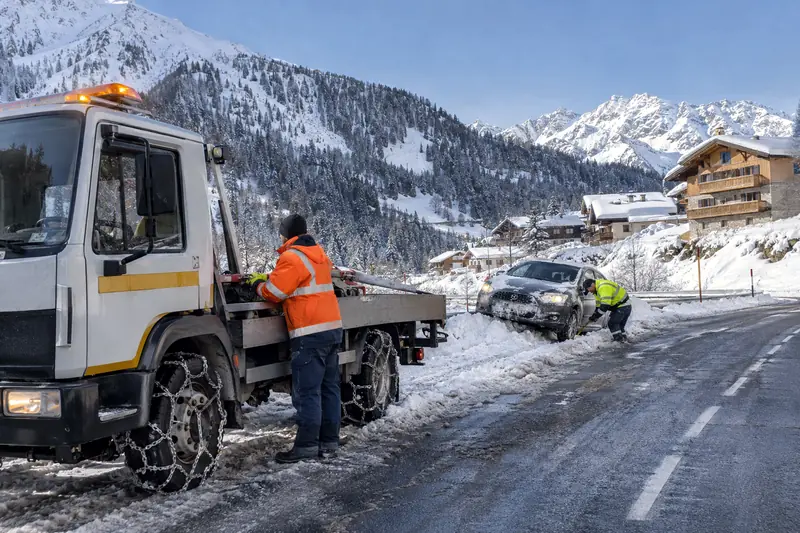
Practise fitting chains in a dry car park, not on a snowy bend. In the cold, a tired battery gives up: a cold start can need up to 2.5 times more power, according to CTEK figures quoted by L'argus. If you break down on a mountain road, give the road, your direction (going up or down), the last village and a landmark: a numbered hairpin, a car park, a ski lift. Recovery trucks may need chains too, so allow for a longer wait.
The Riviera, the Rhône valley and Corsica
The A8, La Provençale, is the coastal backbone: from the Aix-en-Provence area past Cannes, Antibes and Nice to the Italian border. Around Monaco, the A8 and the coast roads carry heavy commuter traffic in the morning and evening; a tow truck sits in the same queues, so any arrival time is an estimate. Monaco itself is a separate state, outside the area these pages cover; on the French side, Beausoleil, Roquebrune-Cap-Martin and Menton are.
The A7 runs down the Rhône valley from Lyon to Marseille, the classic route south. In summer, heat is the batteries' enemy: during the June 2025 heatwave, breakdown call-outs in France rose by 16%, mostly for batteries, according to J2R Auto.
Corsica has no motorway. Its main roads are numbered T10, T11, T20, T30 and T40, and many of them are winding mountain roads: stop only where you are visible from both directions, and give the nearest village and the road number when you call.
If your car has been towed to the pound
A pound (fourrière) may charge at most €135 to remove a car and €7.15 a day to keep it, or €10 a day in Marseille and Lyon: ceilings in force since 1 October 2026. Get the release order (mainlevée) first, then pay at the pound and bring proof of insurance, your driving licence and the car's registration certificate.
A few words of French for the phone
Our line is answered in French. If you call, these phrases help:
- Je suis en panne. I've broken down.
- Ma voiture ne démarre pas. My car won't start.
- J'ai un pneu crevé. I have a flat tyre.
- Je suis sur la route de…, direction… I'm on the road to…, heading for…
- C'est une voiture de location. It's a rental car.
- Pouvez-vous me rappeler ? Can you call me back?
Rather write it all in English? Use the form below: we read it and call you back.
Sources (in French)
- Motorway breakdown rules and 2026 tariffs: arrêté of 8 December 2025 and VINCI Autoroutes.
- Safety vest and triangle: service-public.gouv.fr.
- Winter equipment rule: service-public.gouv.fr.
- Pound charges: service-public.gouv.fr.
Updated November 2026.