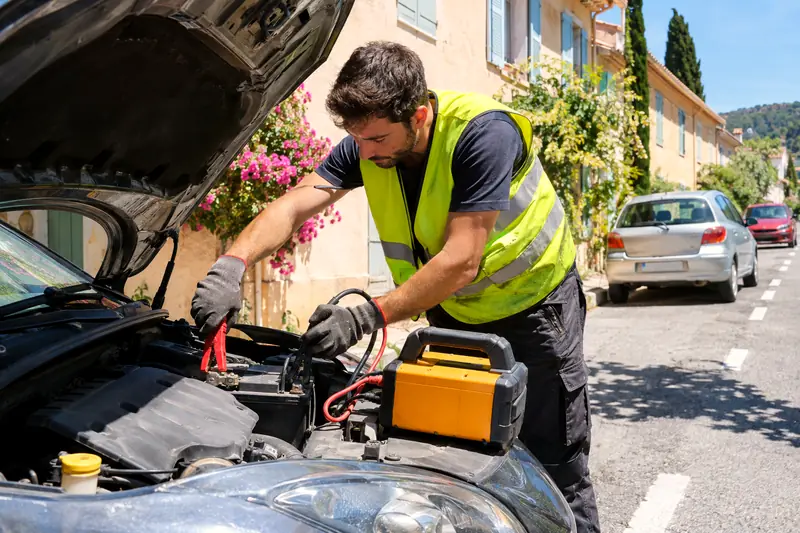
Is it the battery?
- You turn the key or press the button and nothing happens, or you hear a rapid clicking.
- The starter turns slowly, a little worse every morning.
- The dashboard lights dim or go out when you try to start.
- The car has stood for days, or the lights were left on.
If the engine turns over normally but won't fire, the battery may not be the culprit: just describe what you hear when you call or in the form.
Why batteries give up here
In Germany, where the automobile club ADAC publishes detailed figures, the battery caused 45.4% of breakdowns in 2025; France has no official equivalent. The South-East adds its own pressures:
- summer heat wears batteries out, and the failure often shows up later, on the first cool morning. During the June 2025 heatwave, breakdown call-outs in France rose by 16%, mostly for batteries, according to J2R Auto;
- cold in the Alps slows the chemistry and thickens the oil, so the starter needs extra power at the very moment the battery can give less: up to around 35% less performance, and a cold start that can need up to 2.5 times more power, according to measurements by the charger maker CTEK quoted by L'argus (2021);
- a car left for weeks, at a holiday home for example: a battery at rest loses about 0.1 V a month, and a reading of 12.6 V or more with the engine off is a healthy sign, according to the same source;
- short trips, too short to recharge, and power-hungry extras such as lights, demisting and heated seats.
Jump-starting with leads: the order
If you have leads and a second car, this is the order recommended by the Canadian motoring club CAA-Québec; your car's handbook comes first.
- Red clamp on the + terminal of the flat battery.
- Red clamp on the + terminal of the good battery.
- Black clamp on the − terminal of the good battery.
- Black clamp on the engine block, or another bare metal point of the dead car's engine, a good 30 cm from its battery: never on the − terminal of the flat battery.
Start the donor car first, then try the other one, cranking for no more than 15 seconds at a time. Disconnect in the reverse order. Keep the two cars from touching, keep flames and sparks away (a battery gives off hydrogen, which is explosive), never try on a frozen or swollen battery, and wear gloves and glasses if you have them.
On a recent car, a spark can harm the electronics. And when a battery is replaced, some cars need the new one registered by the battery management system, and stop-start cars need an AGM or EFB battery: one more reason to let a professional do it.
Rental car or car of your own?
With a rental car, call the rental company's breakdown number first; it is usually on the rental agreement, the key fob or a windscreen sticker. With your own car, call us or use the form: the tow operator brings a booster and, if needed, a battery for your model.
Updated November 2026. Lire cette page en français.